
AI transformation - What adopting AI really means for organisations
It's time to look beyond optimisations and efficiency measurements
In this series: AI adoption
- Part 1. Agents at work - The build pipeline
- Part 2. Agents at work - Trusting AI-enabled systems
- Part 3. AI transformation - What adopting AI really means for organisations
In this article, I want to lift the conversation up a level or two. To focus less on the technical aspects of AI adoption, and more on the organisational and human aspects instead. Because this is where the real work lies, but also the real benefits.
Looking back
In my first article on AI adoption I focused specifically on the build pipeline, and how AI adoption is currently butting heads with how many organisations have been building up until now. And how this issue is an AI leadership responsibility, caused by lack of direction.
In the second article, I talk about how trust in systems change when they have been "AI enabled", so rethinking how we build this trust is crucial.
But although those two articles belong to a series specifically concerning "AI adoption", there is a recurring theme through several other articles on my blog, namely the disruptive characteristics of AI to many parts of business (and society), and I give hints on how I believe this should be approached.
In People should prepare for a tsunami I write about how most AI attempts fail because companies shoehorn AI into current, decades-old processes that were designed around humans typing code, or building things in general. I also ask some slightly controversial questions like whether code style matters at all if humans neither write nor read the code.
In the short-post claiming that we are holding agents back I posit that business leaders should not ask how AI can save money by continuing the previous trajectory with fewer people, but rather what becomes possible when employees get access to the power of AI.
The article asking about a brain drain was triggered by Kamilla Fredriksen Fon's point that human contribution should move upstream to judgment, problem framing and architecture), and that this has to be designed across the organisation, which I very much agree with her on.
And in my March article about incorporating AI into your business, that point of design (or direction) was what I was looking for rather than just pure experimentation alone (mostly by developers). Management needs to be a part of the adoption, because this is not "an IT thing".
A similar point about management is also argued in my article about Claude Tag, where I say that responsibility lies not with the CTO but with the company's entire management.
Why am I referring to things I have talked about in previous articles? Because there is a larger point to these statements: AI adoption should not be about how much AI can optimise your current processes, or boost your productivity. The "tsunami" is not "all your competitors are doing XYZ ten times faster or cheaper than you". It is instead something much more exciting, but also much more difficult for most companies: how much will AI transform the field in which your company is operating, and to what degree will your company be able to transform itself?
Looking forward
The central thesis is the one I argue in how we are holding agents/AI back: the companies who are now looking to AI to make their processes more efficient, or their costs lower because AI can replace a chunk of their employees, those are the ones who will be left with the shortest straw when they realise that adopting AI was not really about those vv c2 things.
In my LinkedIn post from August 13, I ask if you have (or are) an unimaginative leader. It is presented tongue-in-cheek, but that doesn't mean it's not also a serious question. AI is upon us, and opting out is not a sustainable choice. There are people opting out, which is their prerogative. But I don't consider it a wise choice, because whatever each of us may feel about this, AI is going to shape our future. For better or worse. Or rather, and worse. I think we'll have more impact trying to steer it from within.
The leader or companies without imagination will likely focus on the efficiency aspect. "The 10x developer" and similar terms have typically been interpreted as "10x more efficient" or "10x faster" or "10x more productive".
But I think that's too narrow and pedestrian, because it implies we'll keep doing what we've "always" done, just faster/cheaper.
From AI adoption to AI transformation
AI transformation is something more than that. To get the full benefit (and possibly even to survive), we must dare to challenge the way we work.
But in these days of AI FOMO, employees are getting AI forced upon them as if it's some "do or die" thing. Although that could be the underlying reality for many companies, the way companies adopt AI does not have to be like that.
People are anxious. For their jobs and for their future. And for their children's future. So it's an executive responsibility in companies to change the narrative into something hopeful and optimistic. Exciting even!
Unimaginative leaders struggle with this. They might see competitors being faster to adopt AI than they themselves are, and so rush to force their company to "do AI", too. However, that just demonstrates a lack of vision. Understanding AI is every bit as important for executives as for employees.
How does transformation happen?
Allowing employees to experiment with AI is necessary, but not sufficient. And an organisation cannot transform itself from the top.
"But you just talked about unimaginative and vision-less leaders, and lack of direction! Which is it?"
Yes, nobody said this would be simple. Transformations never are. Management must provide direction and facilitate the transformation. But the transformation itself must come from the bottom. The employees must have ownership and agency. And they must feel safe. That is an executive responsibility.
AI is developing ever faster, but that doesn't mean we must also adopt it in a rush. Not opting out doesn't mean we should rush in.
So what should we do?
Management should ask the question: "What can we accomplish if we match our employees' skills and creativity with the superpowers AI provides?", and then facilitate for the organisation to experiment. Not with how to do the same things faster or cheaper, but instead a blank slate mandate to question the status quo. To challenge it and experiment with how AI might provide a different way to do things than how they are currently done. Not a different way to do the same things, but possibly a completely different way to achieve the same goals. Or even, sometimes, maybe even new goals that replace the old.
Fluency through experimentation
But to get there, employees must first become AI fluent. There are no shortcuts. You have to put in the work. Take a step back, accept that AI development speed is not the measure of transformation speed. A proper trajectory can look something like this:
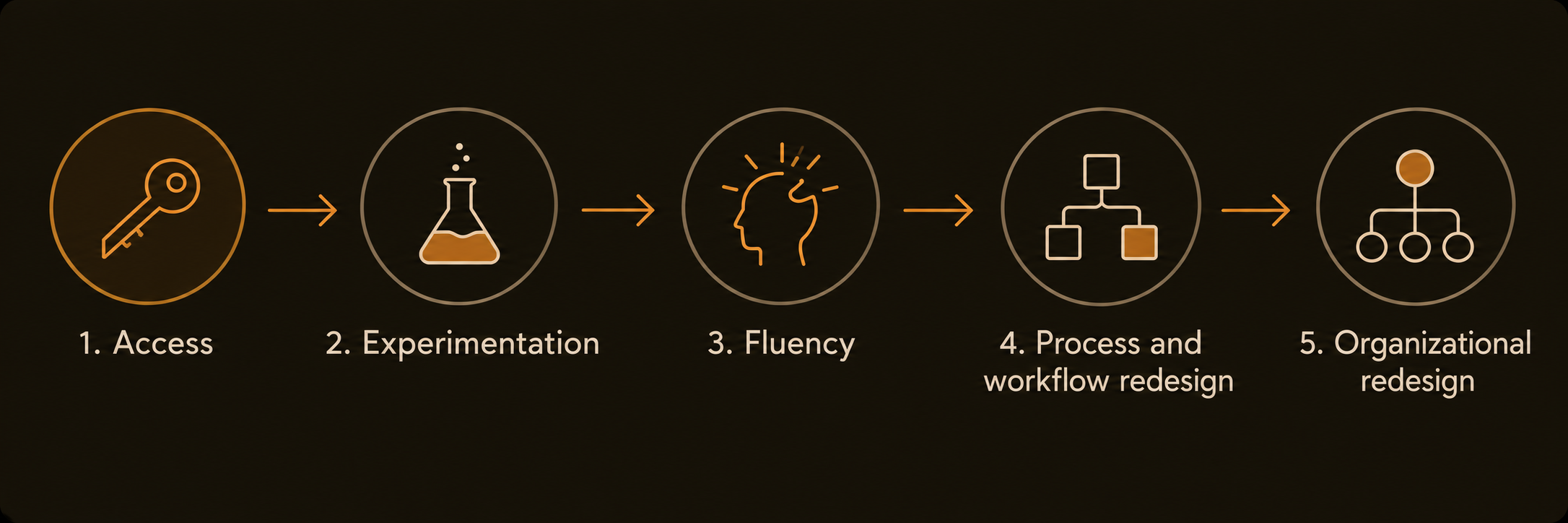
Most companies are at least at Experimentation, though many have just recently allowed Access. But just allowing for some experimentation is not enough, although it is crucial.
Find and encourage internal AI ambassadors(?)
Ambassador is the traditional name for a role like this, but the traditional role isn't really what is needed this time. You need someone a bit more... iconoclastic or provocative, maybe. (Not confrontational, just unafraid of challenging the status quo). Someone with more spirit. Depending on company size, you probably need a few of these. Someone who can both act as pioneers in how they work or how they experiment, but who can also inspire others with their ideas and enthusiasm.
Ideally, these people should be found among your employees rather than being hired as consultants, but that depends on who your employees are today, and the degree of space your company has provided for that type of personality or role before.
But there is one group of people who have traditionally been especially creative, engaged and enthusiastic:
Young and inexperienced newly-hired, possibly straight from school!
We keep hearing how this age group is disproportionately struggling in the wake of AI, since AI is now increasingly doing the type of work this group has typically been given during their "formative years".
What's that you were saying? Yeah, you're right, that's pretty unimaginative. This is today exactly the group of people who have grown up with tech in their hands, and who may therefore be especially well-suited to understand everything that is new and different with AI. Not to mention the fact that they have not yet been indoctrinated by old and worn routines and dogmas latent in most large organisations.
Hire them! Give them trust, lift them up, and their innate technical fluency and their enthusiasm will pair well with experienced employees' know-how and competence to imagine and perform the experiments necessary to obtain AI fluency.
Why do we need to rethink our processes and workflows?
How much of what the organisation does is central for your success? How much of the work people do is work that moves the organisation towards the goals you have set? According to Pseudowork: How we ended up being busy doing nothing: not all that much. AI could be the the catalyst we need to actually transform the way we work.
I have seen plenty of people positing "AI is just another tool in our toolbox", possibly in the name of pragmatism. I don't think that's a useful angle on what is going on now, or on how AI will affect society. But the fear-mongering over AI taking all our jobs isn't very useful either. We need to ask the curious questions concerning how we might use this technology; a technology that outclasses anything we have had to deal with before when you look at it through the lense of speed, and its potential to disrupt society.
Daring to challenge the status quo
The news and social media will keep boiling over with fear, scary headlines, dark prospects for our future, and an overwhelming sense of urgency. This does not create a good environment for dealing with the present and coming disruptions. So we, and especially executive management, have a responsibility to create safe spaces for learning within our organisations, to dial back the fear-mongering, and to create a feeling of optimism and curiosity among employees, allowing them to feel empowered instead of expendable.
This article was also published on LinkedIn.